
The New Convergence Point
- Security, AI governance, compliance and certification are converging, driven by high-profile attacks, government initiatives and closer scrutiny of supply chains.
- Assurance is not only for customers. It is an independent check that what you have in place actually works.
- AI is speeding up delivery, and governance has to keep pace without losing accountability or human oversight.
- One common set of controls, mapped to every framework you need, cuts duplicated audits and evidence requests.
- Culture, leadership and honest scoping decide how ready an organisation really is.
Introduction
Security, AI governance, compliance and certification have traditionally been managed as separate responsibilities, often with different owners, budgets and audit processes. But as cyber risks grow and organisations adopt new technologies, the boundaries between these areas are becoming harder to maintain.
At Concordia, RightCue's client and partner day at Brooklands Museum on 1 October 2026, we brought together a panel of cybersecurity leaders to explore what is driving this convergence, what it means for those responsible for managing risk, and how organisations can move towards a single assurance approach.
The discussion highlighted a common challenge: how can organisations meet growing expectations around security and compliance without creating unnecessary duplication, slowing innovation or losing sight of what matters most - protecting the business and building resilience?
The answer from across the panel was clear; it’s not simply to add more frameworks, controls or systems, but rather make existing efforts work together.
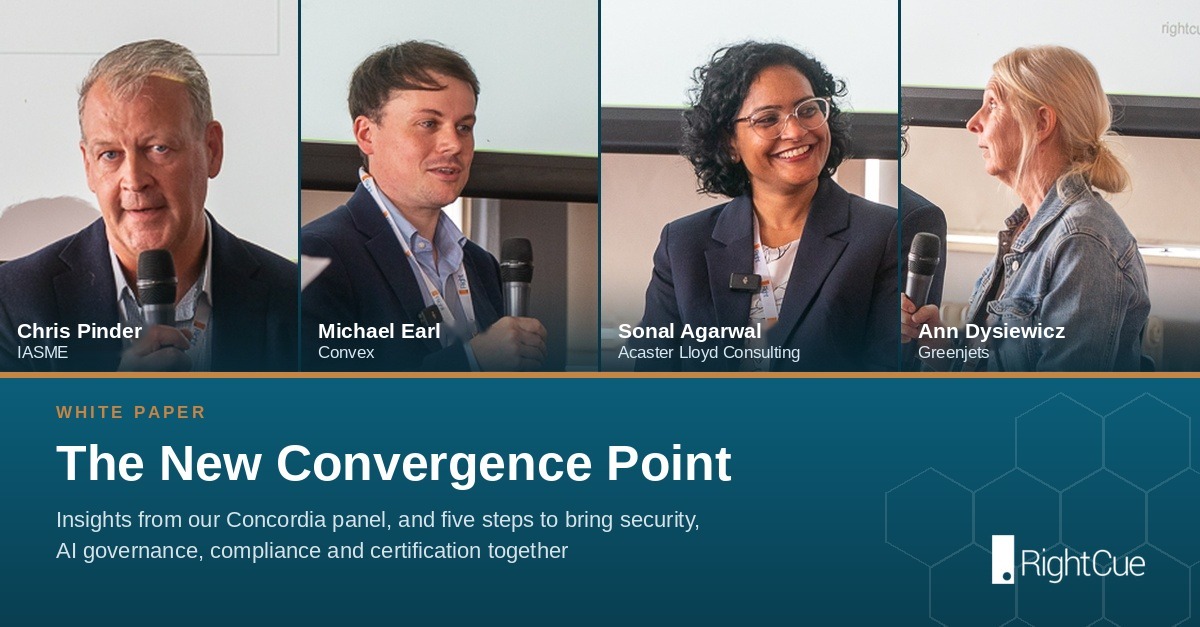
- Chris PinderIASME
- Michael EarlConvex
- Sonal AgarwalAcaster Lloyd Consulting, and co-founder of RightCue
- Ann DysiewiczGreenjets
- Chaired by Antonia TaylorRightCue

Convergence, not collision
Why are security, governance, compliance and certification coming together now? Chris Pinder, who has spent eleven years at IASME delivering cybersecurity certifications including Cyber Essentials, suggested that convergence is a more accurate description than collision.
If they're colliding, they're doing it in a very complementary way for the benefit of all. I think probably a better word would be converged. It's been converging for a long, long time.
Chris Pinder, IASME
Looked at week by week, the changes can seem incremental. Over several years, however, a clearer direction emerges. Chris highlighted three factors contributing to the shift:
- High-profile cyberattacks. Major incidents, including those affecting M&S, Co-op and Jaguar Land Rover, have brought greater attention to organisational security and the potential consequences of disruption. They also encourage businesses to consider the security of their suppliers and wider supply chains.
- A joined-up push from government. Government bodies are encouraging organisations to take cybersecurity more seriously, with collaboration helping to reinforce the message. Initiatives such as the Cyber Resilience Pledge reflect the growing emphasis on stronger digital defences and corporate governance.
- Greater scrutiny of supply chains. Large organisations increasingly want to understand the security credentials of the businesses they work with, including whether suppliers hold relevant certifications and can provide evidence of them. Chris described IASME's work with around 900 large companies seeking information about their suppliers' Cyber Essentials certification.
Initiatives such as the Cyber Resilience Pledge and the MOD's Defence Cyber Certification reflect this wider shift. Security is no longer only an internal IT concern: it is increasingly connected to governance, procurement and confidence across the supply chain.

Assurance is for you, too
Chris described assurance as a promise or guarantee that helps reduce uncertainty. In everyday life, qualifications provide evidence of knowledge and competence. We meet it all our lives, from GCSEs to degrees to professional qualifications. For organisations, it can take the form of standards such as ISO 9001, ISO 27001 and, for AI, ISO 42001.
Certification is often driven by an external requirement. A contract may specify a particular standard, prompting a business to work towards it. Chris noted that Cyber Essentials certifications were growing by around 20% each year.
But he also highlighted a less obvious benefit: while assurance is something we provide to customers, it also helps the organisation itself understand whether its approach is working.
Yes, we do it for our customers and our potential customers. But the one we tend to forget about is ourselves. It's an independent verification that what we have in place is right.
Chris Pinder, IASME
This distinction matters. External recognition can help build confidence with customers, partners and prospective clients, but the process of achieving certification can also prompt organisations to examine their own practices, identify weaknesses and check whether controls are effective. The value of assurance, therefore, extends beyond demonstrating compliance, into a more structured way to understand risk and test business preparedness to manage it.
AI is speeding everything up
AI introduces a new dimension to the convergence challenge: the changing pace at which solutions can be developed, while governance processes may still operate on traditional timescales.
Michael Earl leads security operations and incident response at Convex, a specialty insurer of around 2,000 people:
An individual can go and spend three hours in an afternoon and pop out of that session with a fully built and finished solution. The amount of time that you will then spend shopping that around in the various approval forums becomes disproportionately large.
Michael Earl, Convex
Governance and assurance have always taken time. And while this was acceptable when building things also took time, we’re at a place now where, if governance cannot keep pace, it risks being seen as a bottleneck and losing the support of management.
AI also raises questions about how organisations demonstrate that controls remain effective. If a model's behaviour varies, a traditional audit based on a sample at a particular point in time may not tell the whole story.
This raises several questions for organisations and those responsible for assurance:
- Will sample-based, point-in-time audits remain sufficient in every context?
- Will auditors need to establish which version of a model was operating when a process was assessed?
- Could continuous monitoring play a greater role in demonstrating that controls remain effective?
Michael noted that organisations, including Convex, are establishing AI governance forums. However, adding another approval stage can create further delay if the wider approach is not designed to accommodate the speed of development.
For IT leadership, the task is to develop governance that keeps pace with AI adoption without compromising accountability or security - and is firmly underpinned by human oversight.
One control set, many frameworks
A more joined-up approach to assurance does not mean dismantling existing functions or forcing every team to work in the same way. It is about creating visibility across them, so that the people responsible for different areas of risk can see where controls overlap, where gaps exist and where evidence can be shared.
Sonal Agarwal co-founder of RightCue and former lead of its governance practice, stressed that a "single view" is not the same as single owner or process but about working together as a coherent organisation.
It is about more collaboration and more transparency between the different departments.
Sonal Agarwal, Acaster Lloyd Consulting
She went onto explain that without that collaboration, controls can develop reactively. A new regulation creates another control. An incident creates another process. A client request creates another evidence exercise. Over time, organisations can accumulate layers of controls without gaining a clearer view of whether risk is actually being managed.
Sonal gave an example where she worked with a growing organisation in which information security responsibilities were distributed across the CISO, CTO, procurement and legal teams - and none of them were talking.
We ended up doing the same audit five different times during the year, which just creates chaos.
Sonal Agarwal, Acaster Lloyd Consulting
The result was duplicated work rather than a coherent picture of risk.

Sonal identified two important components of a more integrated approach.
Lead from the top. Senior management needs visibility across reports, measures and certifications, so that decisions are informed by a shared understanding of risk rather than isolated departmental updates.
Create a common control foundation. Organisation should start with a core set of controls that work for their company. Next, they can map their controls against the relevant frameworks, identifying where requirements overlap and where additional measures are needed. Evidence can then be collected once and reused where appropriate, rather than repeatedly gathered for separate audits.
A shared governance, risk and compliance system may support this approach, but technology alone is not the solution. The underlying processes, responsibilities and ways of working must also be joined up.

Culture and leadership decide readiness
Frameworks and controls are important, but they cannot provide effective assurance without the support of the people responsible for putting them into practice.
Ann Dysiewicz joined Greenjets, a British aerospace technology company, mid 2026. As Head of IT, her role is to help the business scale from a start-up of around 80 people towards an expected 300, while continuing to support its research and development, and manufacturing activities.
Her experience is that many compliance frameworks overlap and often ask similar questions. Rather than starting with a certification and building processes around it, her approach is to identify the risks, put the right controls in place, and then map those controls against the certifications and frameworks the business needs.
The aim is to make compliance part of the way the business operates, rather than treating certification as the end goal.
The real change should be in our people, our culture, and the way we work. That’s what makes us more compliant. The certification should be the outcome, not the objective
Ann Dysiewicz, Greenjets
Two things have made the biggest difference for Ann:
- Visible support from the CEO. In her first week, the CEO asked what she needed. Her answer: his support, in an open forum, for what she was trying to do. That support helps establish that security and compliance are organisational priorities, rather than responsibilities belonging to one individual or team.
- Setting expectations from day one. With around 20 new starters a week, onboarding is an important opportunity to establish expectations: Ann believes culture is embedded with positive processes.
Chris made a similar point about assurance more widely. An organisation's readiness is not determined simply by its size or sector. Culture, and whether senior leadership is behind the effort, makes a significant difference.
The implication is clear: assurance cannot be treated as a project that ends when certification is achieved. It needs to become part of how the organisation operates, adapts and makes decisions.
Do the work in clear weather
Frameworks can enable an effective response to an incident, but they can also become a barrier if the necessary preparation has not taken place. For Michael Earl, the difference depends on the work done beforehand.
When you are in an incident response scenario, you shouldn't really need to think about any of the pre-existing frameworks too much at all. It stays out of the way because you did all of the hard work and the planning in advance.
Michael Earl, Convex
The value of standards such as ISO 27001 and Cyber Essentials comes from adopting them in good times, embedding them in day-to-day processes, and having someone independent check they work. If a responder is worrying mid-incident about what an auditor will think in three months, it may indicate that preparation and responsibilities need to be clearer.
Michael also described where AI already helps incident response. During the well-documented CrowdStrike outage, his team fixed affected virtual machines one by one. Today, one person could use AI to write a script to fix the whole estate, then spend a few minutes reading and checking it before running it. Playbooks will never cover every situation, and AI tools can help responders move much faster. But he warned against depending on them: they are cloud services, and they will not always be available.
Ann added another essential consideration: organisations need to know which systems are business-critical, who owns them and what to do if they become unavailable.
These responsibilities should be part of normal operations: when roles and recovery priorities are understood in advance, teams are better placed to respond when disruption occurs.
Scope honestly
For organisations managing multiple standards and certification schemes, the burden of demonstrating compliance can become a challenge in its own right.
One Concordia attendee, working mainly with the public sector, raised the frustration of facing another scheme every week, with each one taking time away from protecting the business. The question was whether government was doing anything to improve equivalence between schemes.
Chris explained that equivalence had so far been piloted mainly with very large organisations whose controls were considered at least as good as those required by Cyber Essentials. Broader recognition across government departments would require government leadership.
Huw Brook of IASME, who helped design Defence Cyber Certification (DCC), explained the concern with certificates that cover only a narrowly defined part of an organisation.
We've seen ISO certificates where people have scoped a box in a cupboard. That's not the intent of those schemes. That's why the scoping of the whole organisation is key.
Huw Brook, IASME
A certificate can only provide meaningful assurance about the scope it covers. If that scope excludes important systems, activities or dependencies, it may not reflect the risks the organisation faces.
That distinction is important. Organisations need to understand which requirements can be addressed through shared controls and evidence, where formal equivalence is recognised, and where additional work remains necessary.
Keep it in proportion
A joined-up approach should make assurance more effective. Asked where organisations should start and where they are heading, Sonal described assurance as a continuous journey. The objective is to recover from an incident quickly and with as little damage as possible, without depending on any one individual.
Frameworks provide guidance, but they must work for the organisation. Too many controls can be counterproductive if they make it difficult for people to do their jobs or encourage them to find ways around the rules.
If you put in too many controls, too many rules in front of people, they find different ways to overcome it. That's why we have the problem of shadow IT.
Sonal Agarwal
AI is one example of where this balance matters. A blanket policy prohibiting its use may be difficult to sustain when employees see commercial opportunities to work more efficiently. But unrestricted adoption creates its own risks.
Sonal described an approach that recognises AI cannot be ignored commercially while establishing appropriate due diligence on providers, clear guidelines for staff and an accessible way for people to report concerns.
The same principle applies more widely. Controls should be proportionate to the risks they address, readily understandable to the people expected to follow them and practical enough to become part of everyday processes.
Assurance is most effective when it empowers people to make better decisions, rather than encouraging them to work around the system.
Five steps towards convergence
The panel's discussion points towards five practical actions for organisations looking to bring their security, governance, compliance and certification activities into a more coherent approach towards resilience.
-
Bring risk ownership together
Security, compliance, IT and leadership need a shared view of organisational risk. Clear ownership and regular communication help teams identify gaps, avoid duplication and make better decisions.
Bring key stakeholders together to agree priorities, responsibilities and how risks will be escalated.
-
Build a common foundation
Many frameworks share the same underlying controls. Mapping these against a single set of policies, processes and evidence can reduce repeat audits and make assurance more efficient.
Identify overlapping requirements and create a central record of controls and evidence.
-
Make culture part of the control environment
Policies and certifications matter, but they are only effective when people understand and follow them. Leadership, training and open communication help make secure, compliant behaviour part of everyday work.
Equip managers to reinforce expectations and make it easy for employees to raise concerns.
-
Prepare before an incident
Incident response is most effective when roles, processes and communication have been agreed in advance. Regular exercises help expose weaknesses before a real incident puts them to the test.
Test your response plan, clarify responsibilities and act on lessons learned.
-
Keep assurance proportionate
Scope controls and certification around the real risks and activities of the organisation. This is particularly important as AI introduces new tools, data flows and potential vulnerabilities.
Review what falls within scope, where gaps remain, and whether AI use is covered by appropriate governance and oversight.
From convergence to confidence
The convergence of cybersecurity, AI governance, compliance and certification is a real opportunity to make existing efforts work better together.
For IT leaders, this means sharing a clearer view of risk, reducing duplication where requirements overlap, building security into everyday decisions and preparing people to respond when things go wrong. It also means recognising that frameworks and certifications are most valuable when they reflect how an organisation actually operates – including from a cultural perspective.
AI has added urgency to this challenge. As the pace of development increases, governance and assurance need to evolve without losing sight of accountability, security or human oversight.
There’s no single certification or system that can deliver this on its own. Progress depends on leadership, collaboration and a proportionate approach to assurance, one that evolves as the organisation, its technology and its risks change.
The clear consensus is that when it comes to cyber security, organisations need to go so much further than simply demonstrating compliance. Rather, each organisation needs to understand its risks, be confident about how it evidences managing them and be better prepared to withstand disruption – this is what real resilience looks like at the new convergence point.

About RightCue
RightCue helps organisations navigate cyber security, compliance and resilience with clear, commercially grounded guidance that puts business first. We are an NCSC Assured Cyber Security Consultancy, a certification body for Cyber Essentials and Defence Cyber Certification, and work with clients on ISO 27001, penetration testing, incident exercising, supplier risk and data protection.
To talk about bringing your security, compliance and certification together, visit rightcue.com.